Journal of Peace, Prosperity & Freedom
Vol. 3, 2014
  • Home
  • About
  • Submissions
  • Current Issue
  • Subscribe
  • Contact Us
  • Donate
  • Join Mailing List
  • Past Issues

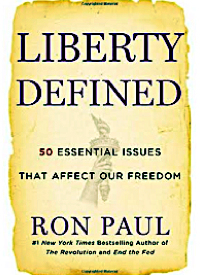
Liberty Defined: 50 Essential Issues That Affect Our Freedom

3/31/2013

0 Comments

 
Picture
MARK HORNSHAW

Written by possibly the most influential libertarian of our generation, Liberty Defined is a must read book. In this collection of essays, Ron Paul lays out a libertarian philosophy on 50 topical issues, arranged in alphabetical order from “Abortion” to “Zionism”. It is a book that can be read in any order you like. But no matter where you start to read, you have to read more.

‘We need intellectual leaders’ said Austrian economist F.A. Hayek, ‘who are prepared to resist the blandishments of power and influence and who are willing to work for an ideal, however small may be the prospects of its early realization'.[1] Such intellectual leaders are hard to find!

A former obstetrician, Ron Paul is a Congressman from Texas and a candidate for the Republican presidential nomination in 2008 and 2012. But nowhere in his book does Paul take even the slightest opportunity to indulge in electioneering or political posturing. Every line and chapter would be equally as potent whether Ron Paul ran for presidential office or not. Nowhere does he say that he is the solution to a problem, if only people would vote for him. At its heart, the book is not about policy prescriptions at all; it is the opposite to the usual political message. It’s about pulling back the proverbial curtain and revealing political schemes and wizardry as being inept and, more often than not, counterproductive. It does this forthrightly, bravely and uncompromisingly – and not just ‘for a politician’ but for anybody.

Ron Paul uses each of the 50 mini essays to hack away at the thick ivy of mystique surrounding government regulations, taxes, programs and schemes. He takes every opportunity to show that governments are the cause, not the solution, to human problems – whether they are related to ‘Slavery’ or ‘Education’ or any other area of concern. The legendary libertarian writer Murray N. Rothbard implores that “the libertarian must never allow himself to be trapped into any sort of proposal for ‘positive’ governmental action; in his perspective, the role of government should only be to remove itself from all spheres of society just as rapidly as it can be pressured to do so".[2]

In these 50 short chapters, nothing is spared from the microscope and the axe, not even the notion of ‘democracy’:


As much as I defend the freedoms of everyone, those freedoms should be limited in the following sense: People should not be able to vote to take away the rights of others. And yet this is what the slogan democracy has come to mean domestically. It does not mean that the people prevail over the government; it means that the government prevails over the people by claiming the blessing of mass opinion. This form of government has no limit. Tyranny is not ruled out. Nothing is ruled out.

If the problem is government, Ron Paul’s solution is summed up in that beautiful and timeless word: liberty. But as often happens with such evocative words over time, liberty has been used and abused in the political mosh pit. It has been so watered down that it can mean anything to anybody. So this book more than anything else is about exactly what the title promises – defining what real liberty is and how a society that embraces liberty might interact with one another in peace and prosperity.

When it comes to foreign policy and trade policy for example, such a society would practice, as Thomas Jefferson famously said, ‘Peace, commerce, and honest friendship with all nations — entangling alliances with none’. He says ‘sanctions and blockades are dangerous and should be considered acts of war’.

A free society would have no place for ‘prohibition’. Paul draws parallels between the various government enforced prohibitions of today, and the havoc wreaked by alcohol prohibition in the 1920s, which bred lawlessness, underworld criminal syndicates, violence and poor quality products that endangered users. Under prohibition all honest people must surrender some of their freedom to the busybody inspectors who want to police the behaviour of others in a misguided effort to correct their habits.

Ron Paul minces no words in calling modern day America a ‘military client-run empire’ which he compares to the Roman Empire of old or the British colonial empire of recent history. With 900 military bases housing US troops in 135 countries, he says ‘Truly, the United States is an empire by any definition, and quite possibly the most aggressive, extended, and expansionist in the history of the world. Do we really find it shocking that some people in the world don’t like this?’ This empire, consuming the lives of American soldiers and the wealth of future generations, is the ‘enemy of American freedom’.

The chapter on unions is particularly well written, and this crude summary may not do it justice. Paul defends the right of people to form groups and to negotiate collectively. But he strongly opposes the use of violence and force against others, and any union powers gained by legislation he puts in this category. Often, big labour, big business and big government combine to enrich themselves at the expense of others. He goes on to show how ‘when the goal is liberty, prosperity flourishes and is well distributed. When economic equality is the goal, poverty results’.

Ron Paul writes to an American audience that is often deeply divided between conservative and progressive, religious and secular, etc. Yet none of these rifts pose any problem to the liberty based society Ron Paul envisions. In the chapter entitled ‘Evolution Versus Creation’ he points out that ‘both sides want to use the state to enforce their views on others. One side doesn’t mind using force to expose others to prayer and professing their faith. The other side demands that they have the right to never be offended and demands prohibition of any public expression of faith’. But on the other hand, he point out that ‘most of the conflict between atheists and believers comes up because of public schools. This issue doesn’t exist in private settings such as homes, homeschools, private schools, churches, and art studios, to name a few. In the private sector, every point of view can find a place and these ideas are no threat to others’.

It is no surprise then that Ron Paul is loved by people of all religious or non-religious persuasions – anybody who wants freedom to live their own life and be at peace with others around them. And he is also feared and ridiculed by people of all persuasions – whose insecurities compel them to employ coercion against others by seeking the reins of power.


NOTES

[1] F. A. Hayek, ‘The Intellectuals and Socialism’, in Studies in Philosophy, Politics, and Economics, University of Chicago Press, 1967, p. 194.

[2] Murray Rothbard, For a New Liberty: The Libertarian Manifesto, Macmillan Publishing, New York, 1973.

0 Comments

The Evil Princes of Martin Place: the RBA, the GFC and the Threat to Australians' Liberty and Prosperity

3/29/2013

1 Comment

 
Picture
STEVE KATES

Moral wrong is related to intentionality. You must wish to do harm if the harm you do is to be a matter of blame. Whatever else the people who run our central bank may intend, they are trying to do good as best they can. To describe the Reserve Bank board as “the evil princes of Martin Place” immediately removes the book from being about economic policy to one about morality and blame.

In spite of that, and to my surprise, the first eight chapters turned out to be a very interesting discussion on Austrian monetary theory and the Austrian theory of the cycle. I have not read everything and there may well be other, better books around. But if you would like to understand the Austrian view of how one of the most crucial parts of our economic system works, and why the way it now operates creates dangers for our prosperity, this would be a very good place to start.

But going back to the title on a different matter this time, I think it’s unfortunate that the author chose a title that would make a potential reader assume it is a book mostly about Australia and its central bank when it is a book about the nature of economic policy and central banking everywhere. And the Global Financial Crisis, as the book makes clear, was not a local Australian event but one which began in the United States and has affected economies across the world. The title will therefore and unfortunately deter many people overseas who might have found the book useful from picking it up because of the implication embedded in the title that it is about Australia without a more general international interest.

Moreover, the arguments of the book are built on a foundation of Christian theology and Roman jurisprudence which may not be everyone’s cup of tea and which might also put some people off. It does take some effort to see the point because of this context. But in many ways the historical journey through Roman law, and the distinctions that were important these couple of thousand years ago, provides a basis for seeing that there are other ways of looking at these issues that once did exist and are now lost. I found this discussion fascinating.

The book also provides an historical review of the various issues that is quite extensive. This is the kind of sentence one does not come across very often in anything written nowadays about economics: “From the earliest days of banking, namely in Babylonia perhaps as early as 3500 BCE . . .” but it is representative of Leithner’s approach.

And this is the message that the author wants you to understand. Economies in which normal banking practice systematically creates loans from demand deposits necessarily suffer economic crises, and these economic crises include the failure of large numbers of banks. Therefore, we should stop banks from lending out the money they hold on behalf of other people. A bank can be a place where deposits are held in relative safety and can be used to transfer money from one person to another. But as soon as banks are permitted to lend money out to other people so that there is less than 100% of the value of deposits on hand in the bank when depositors might want their funds, we are well on the way to banking crises, instability, unemployment and inflation. If you put a stop to fractional reserve banking, where deposits are created from nothing and lent to third parties, these kinds of crises will come to an end and most financial instability of this sort will cease.

This is an arguable proposition and while I don’t think it is a complete story it is a story worth thinking about. The value in this approach is to return theory towards the theory of the cycle where broader causes of recessions and large scale unemployment are seen as intrinsic to the way in which the economy operates. Crises and recessions are not blue sky events but have actual endogenous causes unrelated to deficient demand. It is a different way of thinking about economic issues which has now almost totally disappeared from mainstream economic thought.

But really, the context in which he puts his economic arguments are guaranteed to ensure that hardly anyone at all will pay attention to what he says. What sense can it make to discuss any part of our economic system under the heading, “The Central Bank: Mere Idol or Agent of Satan?” (p 527). He may wish to discuss economic policy and the proper theory behind it, but once he decides to indulge himself in that kind of rhetorical overkill he is ensuring that no one pay the slightest attention to anything he says. Even though there are major moral issues involved which are properly part of any such discussion, theological arguments are not economic arguments. There will be no converts based on such arguments. This kind of statement loses the battle even before there is any engagement at all.

And then there the title of Chapter 9 to consider. After eight chapters that deal with the nature of the fractional reserve system and the problems it might or might not cause, he titles this chapter: “The Monetary Roots of Democratic Pathologies”. And then the first sub-heading in the chapter: “Democracy is Evil!” in bold black letters. Seriously, how completely off putting can any statement be. While nothing is perfect, as Churchill famously said, “democracy is the worst form of government except all those other forms that have been tried from time to time”. Those of us who live in democracies like them and do not wish to be rid of them. No one who is apt to read this book would like to live in any other kind of political system. Had he looked to find some means to discredit his own ideas as thoroughly as possible, it is hard to think how he might have done so more comprehensively than this.

And it’s not as if he puts up an alternative to democracy. Whatever may be the economic consequences of democracy, the economic consequences of any other form of political system are far far worse. If Leithner doesn’t think so, he should at least explain why. To say democracy is bad, and the solution to our economic problems is to get rid of democracy, only makes me think that these problems will never be completely fixed and so we should get on with life.

The bottom line. There is an Austrian theory of the cycle. There is an argument to be made against fractional reserve banking. There are useful theological concepts that might be drawn into these arguments. But when all is said and done, the way the book is written, the political and moral judgments overwhelm whatever economic arguments there are. There is a very interesting book to be written that lurks inside the book that was finally published. If you are able to get past the politics, the morals and the theology, you might find this a very interesting book to read. But these are obstacles that will make it hard for many to see the point.


Download the PDF version of this article by clicking here.

1 Comment

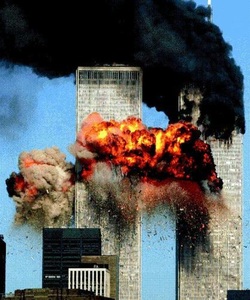
The Years Since 9/11: What Hath Our Rulers Wrought?

3/24/2013

0 Comments

 
Picture
CHRIS LEITHNER

Abstract: On May 2, 2011 the U.S. Government did not even consider the pretence of due process and a fair trial according to the rule of law. Instead, its military planned and executed the premeditated murder of Osama bin Laden (who, among other things, masterminded the killing of approximately 3,000 people on September 11, 2001). But is bin Laden’s death really a time to rejoice? Or is it instead a time to reflect and ask that others forgive our sins against them and that we forgive others’ sins against us? The unspeakable truth is that the ‘War on Terror’ is a war of terror waged upon innocent civilians in impoverished lands – lands which have been impoverished not least by relentless Western meddling. Moreover, the War on Terror is one of America’s most comprehensive diplomatic, economic and military defeats, one which the U.S. Government has inflicted upon its own subjects.

The Years Since 9/11: What Hath Our Rulers Wrought?

0 Comments

McDonaldization: An Analysis of George Ritzer's Theories and Assertions

3/22/2013

1 Comment

 
JOHN ENGLE

Abstract: Globalization is a massively powerful force in the 21st century.  Defined as "the world-wide diffusion of practices, expansion of relations across continents, organization of social life on a global scale, and growth of a shared global consciousness", globalization is perhaps the most noticeable feature of this Information Age.  The growing influence of the ever-expanding technologies and influences stemming from this globalizing phenomenon are irrefutable.  In McDonaldization: the Reader and The McDonaldization of Society, George Ritzer addresses the issue of 21st century globalization in terms of McDonaldization, a concept built on Max Weber’s ideas of rationalization and bureaucratization of society.  Ritzer focuses on McDonaldization, and by association globalization, as a negative force, or grobalization, one built on dehumanizing and often ultimately irrational principles.  However, Ritzer pushes his argument too far, venturing into the realm of inanity.

McDonaldization: An Analysis of George Ritzer’s Theories and Assertions

1 Comment

Individual Freedom, International Trade, and International Conflict: Cobden Was Right

3/21/2013

1 Comment

 
ALEX ROBSON

Abstract: The proposition that international trade in goods and services, factors of production, ideas and cultures increases mutual dependencies, lowers the possibility of international conflict by making it more costly, and allows individual freedom to flourish can be found in the writings of Emeric Cruce, Francois Quesnay, David Hume, Adam Smith, de Montesquieu, John Bright and, more recently, Ludwig von Mises. Richard Cobden, was also a powerful advocate of this idea. Although trade and economic interdependence can contribute to the peaceful resolution of disputes, they are not, by themselves, sufficient to guarantee the absence of war and the reduction of arming, and so they are not sufficient to guarantee the spread of international freedom. But, all else being equal, the gains from international trade—long emphasized by microeconomists as desirable in their own right—are a powerful deterrent against international conflict. And since freedom cannot exist under conditions of conflict or total war, international trade has an important indirect effect on the spread of individual freedom, both within countries and throughout the world.

Individual Freedom, International Trade and International Conflict

1 Comment

Mises' Apriorism - Tautology or Theory of Praxis?

3/19/2013

0 Comments

 
CADE SHARE

Abstract: This paper will attempt to reposition Ludwig von Mises’s methodological apriorism and the Austrian economic method firmly in the Aristotelian realist tradition of apriorism, rather than the more problematic apriorism associated with Kantian idealism. The author will argue that the Misean method whilst aesthetically Kantian, is far more nuanced than semantics suggest. That being, Mises’s methodological apriosm closely mirrors in method and application the imminent realism of Aristolean apriorism, circumscribing to a large degree the analytic/synthetic dichotomy that many positivists claim render Mises’s Kantian methodology both epistemologically sterile and hopelessly anachronistic. Thus, if we can prove Mises was Kantian in a purely semantic sense, we can render obsolete the positivist claim that the praxeological method is mere tautology, and instead establish it as a theory of praxis, given it is claims to the contrary that constitute the most consistent and potentially problematic criticism levelled at the aprioristic science of human action.

Mises' Apriorism - Tautology or Theory of Praxis?

0 Comments

Secession as Political Reform: The Case of Western Australia

3/18/2013

0 Comments

 
SUKRIT SABHLOK

Abstract: Although secession strikes at the heart of many debates surrounding Australian federalism, it is not often raised as an option by reformers of intergovernmental relations. Most proposals from experts focus on tinkering with the federal system by changing elements of the tax and grant distribution systems or creating Special Economic Zones that provide targeted relief from central government intervention. In rare instances when separation is raised, numerous legal, political and economic obstacles are placed in its way. George Williams writes that ‘The constitution simply does not contemplate any part of the nation breaking away, with no state having the right to unilaterally leave the federation’. Others have opined that departure would leave a seceding state exposed and defenceless against foreign enemies, or that a unified system is essential for minimising inter-jurisdictional conflicts in the Oceanic region. Some have questioned whether secession will yield economic benefits for the breakaway region, as there is no guarantee state governments will be less oppressive than the national one.

Our task in this paper is to analyse the arguments pertaining to the exit of a minority from a majority, i.e. to inquire into whether secession is justifiable. The case study of Western Australia will take centre-stage, because in 1933 nearly 70 per cent of West Australians voted in favour of leaving the Australian federation.

Secession as Political Reform

0 Comments

Natural Law and the Libertarian Society

3/16/2013

1 Comment

 
BEN O'NEILL

Abstract: The present article examines the subject of jurisprudence, which is the theory and philosophy of the nature of law.  The purpose of jurisprudence is to analyse the nature of law and figure out what we mean when we say that some rule in society is a law, or that some person has committed a crime or a non-criminal breach of law (e.g., a tort or breach of contract).  This issue is clearly important to libertarian theory, since the claim that government is a criminal institution must be backed by some jurisprudential analysis of the nature of “law” and “crime”.  (In short, if libertarians want to make this claim, they need to define their terms and support their usage of these terms.)  Such an analysis provides the underlying philosophical rationale for claims that the actions of governments are crimes and that these governments may properly be regarded as an organised criminal enterprises.

Our purpose here is twofold.  One is to examine some conceptions of the nature of law and the semantic issue of which meaning of the terms “law” and “crime” is the most sensible in the context of an examination of the actions of government agents.  Another is to see why this semantic issue matters in the advocacy of libertarian ideas.

Natural Law and the Liberal (Libertarian) Society by Liberty Australia

1 Comment

The State - Errors of Classical Liberalism

3/16/2013

0 Comments

 
HANS-HERMANN HOPPE

Abstract: Among economists and philosophers two near-universally accepted propositions exist:

1. Every "monopoly" is "bad" from the viewpoint of consumers. Monopoly is here understood in its classic meaning as an exclusive privilege granted to a single producer of a commodity or service, or as the absence of "free entry" into a particular line of production. Only one agency, A, may produce a given good or service, X. Such a monopoly is "bad" for consumers, because, shielded from potential new entrants into a given area of production, the price of the product will be higher and its quality lower than otherwise, under free competition.

2. The production of law and order, i.e., of security, is the primary function of the state (as just defined). Security is here understood in the wide sense adopted in the American Declaration of Independence: as the protection of life, property, and the pursuit of happiness from domestic violence (crime) as well as external (foreign) aggression (war).

Both propositions are apparently incompatible with each other. This has rarely caused concern among philosophers and economists, however, and in so far as it has, the typical reaction has been one of taking exception to the first proposition rather than the second. Yet there exist fundamental theoretical reasons (and mountains of empirical evidence) that it is indeed the second proposition that is in error.

The State - Errors of Classical Liberalism by Liberty Australia

0 Comments

Comment on Sukrit Sabhlok, 'Secession as Political Reform: The Case of Western Australia'

3/13/2013

0 Comments

 
BRAD TAYLOR, Australian National University

This paper argues for the general desirability of secession and in particular that Western Australia should unilaterally secede from the federation. While I broadly agree with the paper’s conclusions, I have a number of issues with it as a piece of academic work. The paper in its current form is a well written polemical essay, but it does not fairly consider the arguments for and against secession in general or WA secession in particular. The paper could be considerably improved by dropping the polemical style and considering other viewpoints more seriously. There are plausible mechanisms through which secession could decrease liberty, and this should be admitted.

First, the use of the Rothbardian individual rights argument is out of place here. I’m not a huge fan of these arguments in academic work at the best of times, but it seems like a simple category error to use Rothbardian language to defend what is essentially a group right. If I am interpreting it correctly, the claim is that since individuals have the right to choose what rules will govern their behaviour, a territorially-defined group of individuals within a state has the right to cut ties with the existing state and set up its own set of rules. I can buy this argument when there is genuine unanimity, but that’s never going to be the case in an area as big as WA. If some WA residents prefer to live under the rules of the federation, wouldn’t their rights be violated just as seriously by secession as are secessionists’ by federation?

I realise that this argument has been made by others such as David Gordon, but that doesn’t make the argument any more correct. Since this seems to be main basis on which the author claims that rights of secession are (deontologically) moral, there are three potential ways of addressing this problem: (1) make the connection between individual and group rights in some other way; (2) explain more fully how the Rothbardian logic applies to groups (I can’t see how the argument is supposed to work, but I may just be missing something; or (3) abandon the attempt to provide a deontological justification for a right to secession. I’d favour the third option, but I’m generally partial to consequentialist arguments in any case.

Secondly, the section on potential objections is extremely cursory and makes no attempt to engage with what various people have had to say against secession. From a libertarian perspective, the most important objection to secession is that the seceding region will sometimes seek to oppress minorities within its borders. This is dismissed in the paper by pointing out that two wrongs don’t make a right: If the national government is violating the rights of the region, the fact that the region is violating the rights of some subregional group is irrelevant to the wrongness of the national government’s oppression. This is based on a misunderstanding of the argument, which has been made with respect to secession (by A. Buchanan and Beran, among others) and also to the power of subnational units in a federal system (Most notably by Madison in Federalist 10 and William Riker in his book on federalism).

The argument is that in a subnational group like WA may contain subregional groups which would be oppressed by a WA government if such a government existed and had the power to do so, but not if the national government had the power to set policy. The concern is that there may be factions (i.e. groups with a common interest in violating the rights of others for material or expressive reasons) which are a minority at a national level but a majority in a certain region. If the region secedes (or the state in a federal is given too much or the wrong sort of power to set policy), the local majority faction will be able to oppress other residents of the jurisdiction. Without secession or with more federal control over policy, such oppression would not take place, since the faction is only a small minority at the local level. The classic example of this is slavery in the US. There were powerful interest groups in the southern states seeking to keep slavery in place as public opinion at the national level was shifting towards abolition. I realise that the common perception that slavery was the reason behind the civil war is not quite right, but the fact remains that preferences and interest group influence was distributed in such a way that more federal control with no possibility of secession would have produced a quicker end to slavery.

I think that argument against secession from a classical liberal perspective is potentially pretty powerful, but the question is how broadly it applies. My prior is that it’s only applicable in a serious way to a few times and places (and even in those instances the benefits of secession could dominate), but it can’t be dismissed as incorrect without argument. It would be much better to admit that this is a potentially relevant factor and ask whether it’s relevant to WA. I don’t know a lot about WA, but my guess would be that it’s not.

Similarly, the economies of scale argument is dismissed by pointing out that Hong Kong and Singapore have performed well economically. The scale argument does not tell us that bigger is always better, but that economies of scale are something to consider. There are undoubtedly economies of scale in the production of various government services and this needs to be admitted – smaller isn’t always best in every respect. Again, it would be more convincing to consider economies of scale as a potential disadvantage of secession, while pointing to possible diseconomies and asking how the argument applies to the WA case. A solid analysis with firm here would have to be rather extensive, but a decent case could probably be made informally.

Some of the comparisons in the paper are also unfair. It is pointed out that federal regulation imposes costs on residents of WA and concludes that WA residents would be better off without federal interference. This will not necessarily be the case, since a WA government is likely to replace federal policies with its own, and these may be better or worse. An argument could be made that policymaking at the local level will be better suited to the needs of residents, but this paper doesn’t make such an argument.

In general, the paper makes an important point but is too shallow in its analysis of the benefits and costs of secession. The argument gives no ground whatsoever on the desirability of secession, and this is generally a good prima facie reason to reject the argument out of hand. Many people apparently oppose secession, while their reasons for doing so may not be compelling all things considered, these reasons normally reflect genuine concerns. The paper could be significantly improved by reframing the paper answering the question “Is secession desirable (and feasible) for WA?” Arguments for and against should be considered on an even basis. Sabhlok is obviously inclined to answer the question one way rather than another (and I’m inclined to agree with him), but it is important that the alternative is given a fair hearing.

0 Comments
<<Previous

    Author

    The Journal of Peace, Prosperity and Freedom is a peer-reviewed academic journal that covers all the social sciences. The JPPF Online is an online forum for scholarly discussion, commentaries and responses to print articles.

    Archives

    December 2015
    April 2015
    January 2015
    December 2014
    July 2014
    June 2014
    August 2013
    June 2013
    April 2013
    March 2013
    January 2013

    Categories

    All
    Civil Liberties
    Economics
    Volume 1
    Volume 2
    Volume 3

    Sponsors
    Picture

    RSS Feed

Powered by Create your own unique website with customizable templates.